
2026 has already been dominated by a few topics that, no matter where you sneak off to, you just cannot get away from.
- Shaken Geopolitics.
- Reprioritizing Health.
- Crumbling Socioeconomics.
- Controversial Bunnies.
- Overwhelming AI Presence.
But that one though– that very last one. That topic is dominating all platforms. It ranges from the self-education push of “how to harness AI tools for small businesses in XYZ” to the flood of AI content generation services, and then to the fear mongering of “AI is going to steal all our jobs”.
As a species, we are evolving, and so are our tools. But what does that mean for our engagement, human to human? Or even, human to business?
Content is getting created faster, longer, and…emptier.
Stories and educational content being shared lacks the human touch. No matter how relevant or applicable the points being made are, the writing itself falls short in connecting to the audience and their own personal pain points.
But the enemy isn’t AI– it’s laziness.
The tools being utilized for generative AI content creation and copywriting are often based on the large language models (LLMs) that are dominating all aspects of how humans conduct business online. These models assume average is acceptable. They are designed to guess the next word based on the statistics of how the topics being written about have already been written about.
The laziness comes into play when one-shot prompting is typed in, copied over, and never even reviewed or edited to bring your voice and your revolutionary ideas to the frontline.

When we minimize effort, we muffle our own mission.

The Middle of the Road Trap
If you live on the edge of your industry, bringing new ideas, processes, and perspectives to the table, with high hopes of seeing tangible changes, you have to understand that LLMs live in the middle of the road.
They are programmed to predict the average next word. The dataset they are pulling from to find the statically most probable next word choice? That depends on the structure of your prompt and what the LLM itself can find across the internet.
If you think about how much of the content on the internet is turning to being AI generated text with little to no copy review, it becomes AI finding the midline in the dataset of other AI writing that has already been sown into the midline of their own prompted datasets…and on…and on…
Large Language Models as optimizers are designed to smooth your edges.
How are you going to cut through the noise with an edge that’s been sanded down to nothing?
When I guide our clients on speaking to their chosen demographic, I often ask them how they speak– and not specifically in regards to syntax and grammar– no, I’m asking more about perspective.
Are they speaking to hear themselves talk?
Or are they speaking because what they have to say is valuable enough that it can be set in a language to be heard and understood?
This is when knowing how your demographic speaks benefits your message. It’s also why understanding the sterilization of language that comes from LLMs is even more important.
The Erasure of the Outlier
A key element of the foundations of Large Language Models is to find the next average word. Your demographic, if it is isolated from the average, the marginalized, the underserved, or hasn’t even been put on the map yet because of the common disregard, then their dialect, slang, strong outlier opinions, and all the other special elements that go into their language of experience isn’t even considered in AI generated text.
So what does that mean to you and to your audience? It means you are pulled and plucked from your niche, both in mission and in demographic.
You, and those that are screaming aloud for your help, are muffled.
Fixing this can feel counterintuitive to using all those “magic tools that will cut all your work in half!” because fixing the blasé blocks of generative AI content creation requires a bit more work.
Hear me out, though– it’s more of an investment on the front end rather than just doubling work for no reason.
If you spend a bit more time in the frontend prompting process, explaining in detail your work, your mission, your vision, your demographic, and their actual pain points you wish to see solved, then what comes out in response speaks more to the topic at hand, not just some offshoot that was easier to balance to some imagined midpoint.
As for how to humanize AI content, you will still need to read through and edit what is generated, but at the end of the day, you are able to use a tool to amplify the voice of your mission, not muffle it.
If that is too much work for you, then try this.
Ask yourself, “If I don’t have the time to explain my life’s work, am I even really doing the work?”

Okay, so to be clear, I use AI. AI is not evil, it’s just another tool in the workshop. But, to successfully use a tool, you have to understand how to use it and how to use it safely. You wouldn’t tell a miter saw to build a cabinet for you, would you?
No! Of course not! That would just be silly. So, why are you asking AI to create the content that you’re publishing? That is not what it’s good at, because it uses language models based on already existing information to cast an extremely wide net for an audience that doesn’t really exist.
Sure, you can learn to get really good at prompting AI tools for content creation to come pretty close to what you want, but it’s never going to be perfect. It will always require human input, and human editing, to achieve the desired results.
The way I use AI is as a research tool. For example, we’re taking on a new project for a client in an industry that I am personally not super familiar with. AI tools for SEO can help me learn the language used in the industry, it can find very successful people that work in that field, and it can help me get to know who their client base (or target demographic) is. These things help guide the way I write and format for the project.
When I’m assigned a copy editing job, I frequently get handed a piece of AI slop that the client “just wants keyworded.” Well, unfortunately, that’s not really how that works. My services, just like Atlas’s, come from a foundation of SEO. Search engines will recognize signs of AI writing. Every single time. And that automatically lowers your ranking because it affects your E-E-A-T-ability, and your page will just register as a bot or spam page. Don’t Do That.
Your voice deserves to be heard, so don’t hide it behind a robot.
Now, if you think you’re, “just not a very good writer,” or you, “just don’t have time to do all that writing,” by all means use AI. But use it to get your rough draft. Then go through and edit it. Make it sound like you, because I promise the robot does not sound smarter or more engaging.
If you decide to use AI tools for content creation, here are some signs of AI writing that you should watch out for, so you can successfully humanize your copy:
- The Hallucinated Bridge:
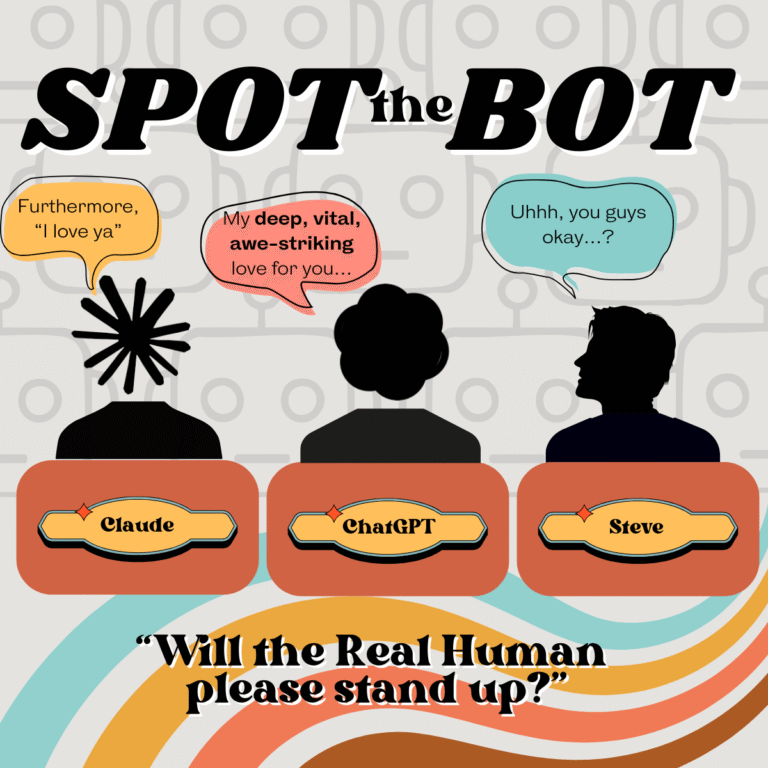
AI is not very good at transitions. It will use generic connectors that feel out of place in your copy, like “Furthermore,” “ In the litigious world of…,” or “Consequently.” While those transitions have their place (in academics), do you talk like that? No?
The Fix: Replace it with something you would actually say, like, “But, here’s the thing…” or “Let’s be real…” Writing like you would have a conversation helps engage your readers, because it feels like you’re writing directly to them. If it sounds like the prompts on a self-checkout machine, people are going to stop reading. - The Confident Lie:
AI will tell a partial truth or outright lie with as much confidence as that one weird uncle after a few too many Bud Lights at Thanksgiving Dinner. Maybe it pulled information from a social media post that it can’t differentiate from a reputable source (hello, Reddit), or it combined information from three different sources as if they were all discussing the same thing, or it just cherry picked a statement from an article while ignoring the context.
The Fix: No matter what the situation, always ask to see the sources or “show your thinking behind…” If it would have dropped your high school social studies paper down a letter grade, get rid of it. - The Adjective Salad:
Bots will try to humanize themselves by stuffing in descriptive language or power words, whether that be some strange, flowery, waxing-poetic language like “breathtaking,” “awe-inspiring,” or (and this one actually comes from a piece of AI writing I was handed to edit) “…living with a deep love for our state’s incredible landscapes. We enjoy the lush forests, the scenic rivers, and the vibrant communities nestled among them.” Or, it will overuse words like “ensure,” “vital,” and “crucial.” And AI loves ending content with, “In conclusion…” Sure, humans might use these words and terms, but when it doesn’t fit the copy, it will come off disjointed and off-putting.
The Fix: Just replace this nonsense. Not everything needs an adjective. Think about what the statement is about, and restate it in your own words like you were talking to a friend. Or, maybe like talking to your grandma. Since you probably shouldn’t use obscenities or shorthands in your copy (yes, that means no “lols”).
Now, for the final, big self-tattling giveaway AI-isms in writing to avoid, that requires almost zero cognitive energy to catch: if it “quotes phrases” where quotations don’t belong, or it bolds words for no apparent reason. Those “quotes” means the prompt included specific language the AI doesn’t understand, and bolded words are where the prompt told the bot to specifically use that phrase.
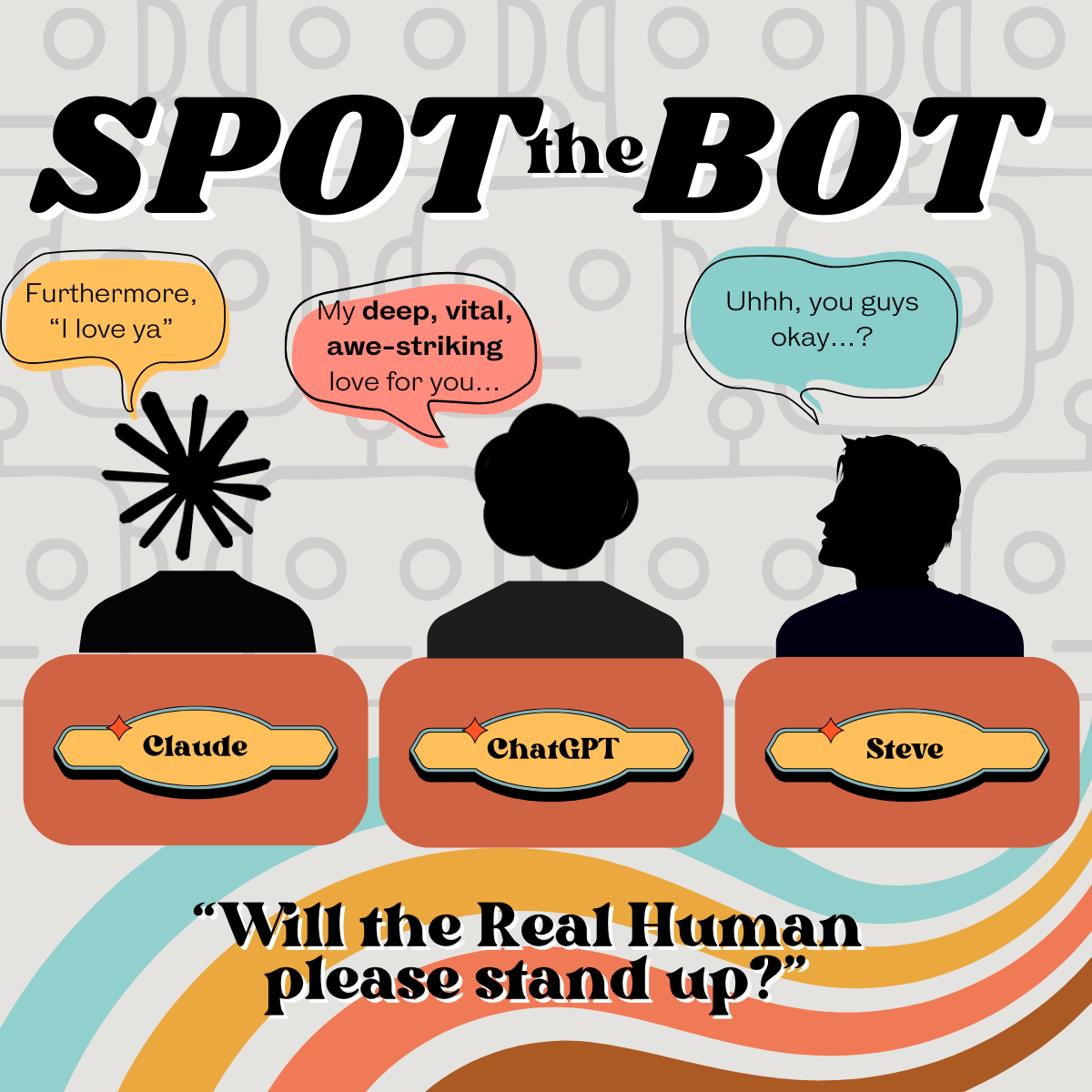
Spot those tells, and you’ve spotted a bot.
A little post script on AI and writing: if you are filling out documentation (like an SEO intake) and decide to use AI to help you answer the questions, PLEASE review the AI responses and make sure they are accurate! Or, at least read through them and know what it says. It is very frustrating to hand in a full package of copy for the first round of edits, just to have the client point to something and say, “what is this? That’s not right!” Then, I show them exactly where in their SEO intake they said the words in my copy. This happens more often than you would believe, and I always come with receipts.

You’ve made it this far, and honestly, I want to applaud you. You’ve learned where your edges are being dulled by the very programs you thought were helping you. Jacob shed light on how to spot the signs of AI writing slop, either coming from your desk or landing on it, and you took notes (I hope).
But there has to be something a bit higher level to work into your flow that cuts down on the extra attention you are feeling forced to give. Stacking your habits and building workflows that feel automatic and tip-top do take a minute to establish, but I promise you, once they are set, it’s smooth sailing for you and your autopilot from there.
So, let’s frame it a little differently here. The goal isn’t to stop using AI tools for content creation cold turkey. The goal is to stop surrendering to it.
To do that, you gotta train it like it’s a new subcontractor coming into the fold– seemingly autonomous in their field, but still in need of some hands-on training for the where and the how you operate as your own entity in that very same field.
The Sandwich Method
Any sandwich with only one ingredient, well, 1) isn’t actually a sandwich, and 2) isn’t going to taste good enough to be meal prepped through the week. When you layer all the goodness into the final product, though, your taste buds are going to be happy.
The Bottom Slice
This is your prompt. This is what you slap down on the cutting board first to build all the yumminess on top. But how you start is going to affect how it all comes together in the end. Think of the ingredients that are going to be layered to build the entire flavor profile of the sandwich. Now think of the base – what does it need to be to actually hold all those ingredients, highlighting the flavors, textures, and colors of each as they feed into the whole?
The same goes for your prompt. What elements need to be included in your prompt to ensure the text generated is holding all the flavors you want included, together?
The Speaker: POV
Who is the speaker in the generated text? Is it you? From where are you standing? Your specialty, your mission, your big, hairy, audacious goal? Yeah? Well, did you explain all that in excruciating detail?
The Reader
Who is the chosen audience of the generated text? Your peers? The demographic you are hoping to relate to? Sell to? Where are they on their own journey? Are they just discovering your work and your perspectives? Or are they already educated and ready to make a purchase? What are they hoping to get out of reading your content?
The Style
What is the language you are wanting to use? Academic? Regionally specific dialect? Highly technical or layman’s language? Is it first person or is it collective? How long do you want the copy to be?
It’s a lot to go into just a prompt I know, but it is worth formatting these elements. I promise.
My suggestion to you: Write this out in a separate document. Include a writing sample of your own tone and style– that one piece you absolutely freaking love. Keep it on hand to copy and paste when a new prompt is needed. Or, if you are working with some of the higher levels of the Large Language Model updates out there, find the “Saved Info” tab in your settings and plug it all in there. Doing this applies the structure to all chats created from there.
There you go. You devoted one session to compile all the needed information, and you plugged it in one time to cut on the extra work that comes with having to recraft the parameters of every single prompt.
The Meaty Middle with All the Mix-Ins
When you are lucky, all your ingredients are already of the highest quality and come with their own flavor profiles. You are just here to adjust how they all work together.
That meaty middle and all those ingredients? That’s the AI draft copy. This is what comes after you’ve plugged in that polished prompt. It will come with all the layers and sources, adjectives and structure– some of which you didn’t even ask for. Marvel at it. There is a lot that goes into bringing it all together with your sauces and top slice.
The Sauces and The Top Slice
Do not hit publish on (or serve) a sandwich that hasn’t been properly dressed. This is where your true artistry comes through.
Review the AI generated text. Does it sound like you? If you can’t quite tell, just read it out loud. You’ll find where you trip over words, where the sentences feel disjointed, or where the adjectives feel like a bit much. Any place where it is too heavy, remove a bit of the flavor– no sandwich feels good to eat if you see all the ingredients, but only taste one overwhelming flavor.
When you come to the end, consider, what is it missing? What is that secret “you” ingredient? Does it need a bit more of a zing (some sass)? Maybe a touch more salt (that regional dialect)? What about that unexpected ingredient– your revolutionary industry opinion?
Add that in.
Slap the top slice on top.
Boom, you just got yourself a chef’s kiss.
The 10% Rule
This one is a bit more simple and a good rule to check your work against. All AI generated text you are reviewing and editing (because you are reviewing and editing it, right?), make sure you are changing at least 10% of all the copy. And 10% is a low number, I know, but trust me, the deeper you dive, the more edits you will make. The place where you will most likely find yourself editing is in the adjectives and the verbs.
Remember, make it sound like you! Some folks say the rule of threes or alliteration are dead giveaway signs of AI writing, but sometimes it’s just how you write. I know it is for me, and you better believe I am keeping it in, regardless of what some people might say.
If you haven’t reviewed and edited your AI generated text, then you’re really just forwarding an email from a robot (don’t do that).

In a world of infinite average content, opinion is the only scarcity. Being professional used to mean sounding corporate.
In 2026, being professional means sounding like a person who gives a fuck.
Find your rhythm in your writing. Add your inflections. Be messy with your speech patterns– that’s more human and more relatable than you realize.
The beige sea of the blasé is rising. You can float in the middle, safe and invisible. Or you can swim to the edge. The edge is where the rocks are. It’s where the risk is. But it’s also where the view is.
Don’t let a predictive text model predict your future.
Write the thing only you could write. Even if it has a typo.